


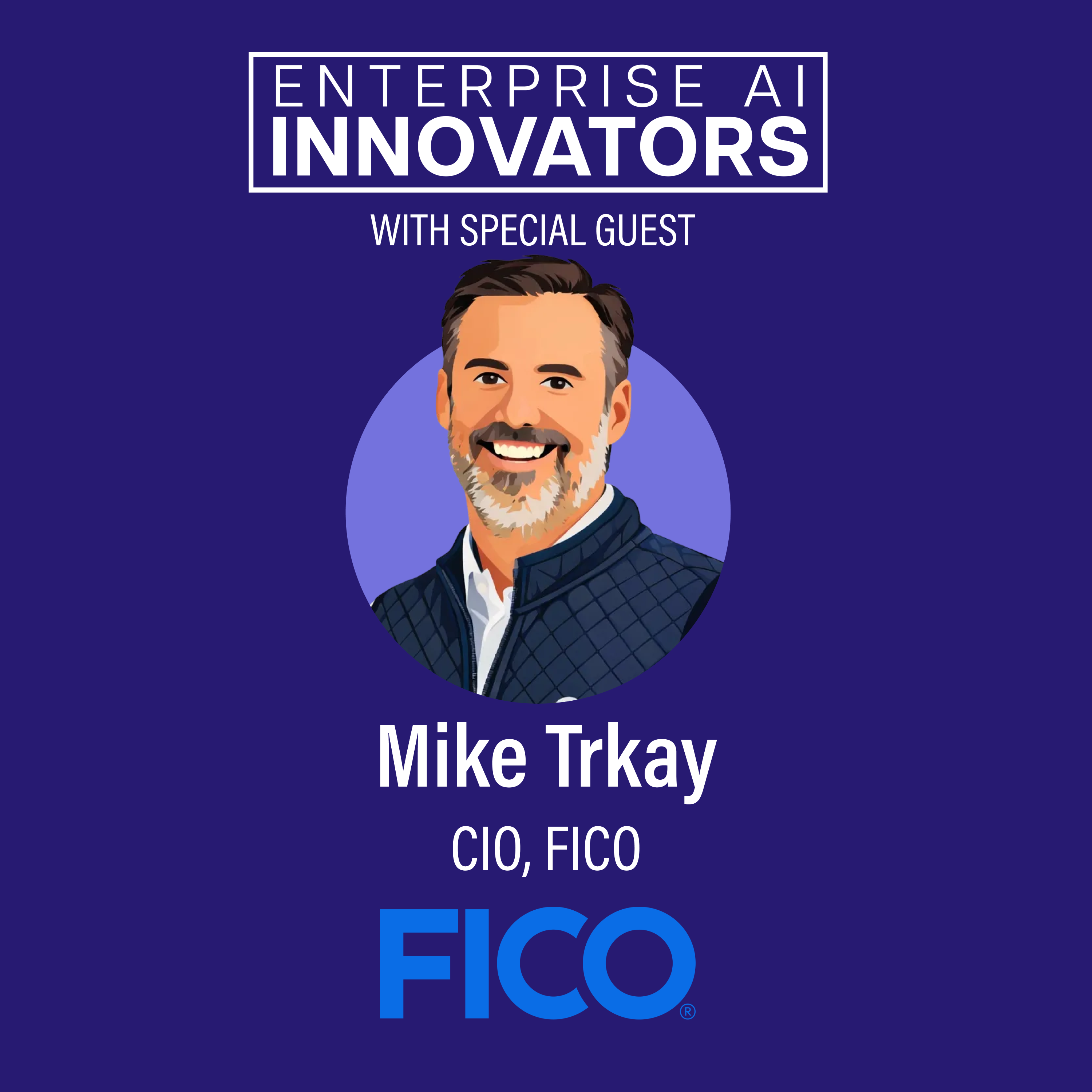
Ep 62: Moving AI from Pilots to ROI with FICO CIO Mike Trkay
On the 62nd episode of Enterprise AI Innovators, Mike Trkay, CIO at FICO, joins Evan Reiser and Saam Motamedi to share how FICO is moving past AI pilots into enterprise operations, including platform governance, data controls, and high-ROI workflows like enterprise search and event intelligence.
On the 62nd episode of Enterprise AI Innovators, hosts Evan Reiser (CEO and co-founder, Abnormal AI) and Saam Motamedi (Greylock Partners) talk with Mike Trkay, CIO at FICO. Mike explains how FICO is moving AI from pilots to production by prioritizing ROI, data foundations, and governance. He argues for sanctioned LLM access to curb leakage, system integration for business-wide answers, and smaller domain models when accuracy, compliance, and trust matter.
Quick hits from Mike:
On the shift from pilots to ROI: “We’re leaving that phase and starting to get to the point of going, okay, but where’s the true return on that investment?”
On the must-do for enterprises: “Everybody who works for you… they’re going to go use one of the LLMs somewhere… and probably share data and proprietary data.”
On why one big model is not enough: “Sometimes you need the PhD. Who’s got who speaks the jargon, understands the context, and it helps deal with some of the hallucinations and bias, and other things that could be influencing.”
Recent Book Recommendation: The Forgotten Founding Father: Noah Webster's Obsession and the Creation of an American Culture by Joshua Kendall
Episode Transcript
Evan Reiser: Hi there, and welcome to Enterprise AI Innovators, a show where top technology executives share how AI is transforming the enterprise. In each episode, guests uncover the real-world applications of AI, from improving products and optimizing operations to redefining the customer experience. I’m Evan Reiser, the founder and CEO of Abnormal AI.
Saam Motamedi: And I’m Saam Motamedi, a general partner at Greylock Partners.
Evan: Today, we’re talking with Mike Trkay, Chief Information Officer at FICO. Now, most people know FICO for credit scores, but its software actually powers many of the invisible decisions happening around us every day: the fraud alert on your credit card, TSA security screenings, even logistics systems figuring out which packages go on which trucks. They’ve been doing machine learning at scale long before the current AI wave.
A few things stuck with me from this conversation.
First, Mike talked about how the AI hype cycle is maturing. We’re past the “isn’t this cool” phase of a thousand small pilots, and companies are now asking harder questions about ROI and picking just a few bets to go deep on.
Second, he made a compelling point about the differences between focused language models and general-purpose LLMs. His example was great. If you’re in financial services and you say “treatment,” you mean collections recovery, not skincare. General models get that wrong, and in regulated industries, that kind of precision matters.
Finally, he’s got advice I think every CIO needs to hear: just assume your people are already using ChatGPT or something similar, and some of them are probably pasting in sensitive data without realizing it. His take is this: Don’t fight it. Give them a secure, sanctioned option before shadow AI becomes a real problem.
Mike, first of all, thank you so much for joining us today. Saam and I were looking forward to this episode for many reasons. Before we go into some of the technology and innovation stuff, do you mind sharing with our audience a little bit about your background? What do you do today, and what inspires and motivates you to do that?
Mike Trkay: Yeah. Today I’m the CIO here at FICO. It’s a little bit unique of a role than what you think of when you hear the term CIO. I do tend to have a lot of the traditional CIO functions—think about back-office IT, the systems we use to run our business—but that’s probably about 10–15% of my mindshare.
The bulk of my focus is really on the technical operations and customer support associated with our enterprise B2B SaaS and PaaS business. It really is about how do we run our platform for consumption by our customers. My team takes everything from the pipeline for deployments to the solution support, customer onboarding to the customer experience and customer support.
So we’re the ones picking up the phone when people have questions and issues.
I didn’t get into that space by design, necessarily. I was an engineer by background and education—really kind of in a mechanical, structural sort of space. I chased the money a bit and went into management consulting when that was the thing to do, when the Big Five were still the Big Five.
But I always call it the best MBA I never paid for, because I was in a group at the time that was a small group. I was a consultant—it would be the C-suite and a couple of our partners. And this is, I’m going to date myself here a little bit, but like 1998.
And that’s Bank of America going like, “What is online banking? Should we be getting into that?” Or Warner Music going like, “Napster is just a bunch of kids downloading music in their dorm rooms. There’s no real business model there.”
And we spent years talking about what is technology and how can it be used to help transform the business.
From there, it just kind of moved me into management and technology roles throughout my career at different places in media and entertainment, and now into the software space at FICO.
Evan: Do you mind sharing a little bit about what you guys do? How do you help consumers?
Mike: A lot of what people don’t realize is that your FICO score is really a model, right? It’s an analytic model that you apply a set of data to, and it gives you basically a risk assessment or a risk score of creditworthiness for an individual.
Well, we have a number of other software products that do other analytics embedded into the software to kind of solve those problems.
Everything from: if you’ve ever been flagged by extra security by the TSA, that’s actually FICO software running in the background. If you ever get that phone call that says, “Hey, we see some weird transactions on your credit card—can you validate this is you?” FICO owns like 80% of that market globally in terms of fraud and risk management.
Big logistics companies run our software to figure out what boxes go on what trucks, or what airplanes pull into what gates, to minimize the transfer time for crews and passengers and everything like that.
So if it’s an analytics sort of problem that is a high-value decision but is repeatable—something that you’re doing over and over again—this is where FICO has, for decades, played a big role.
We’ve had, whether it was AI, analytics, ML—pick the term of the moment—we’ve been in that space for quite a long time and figured out how to really operationalize that, run it at scale, ultra-low latency, and kind of make it enterprise-class and enterprise-worthy.
Saam: You’ve been through multiple technology waves. Where are we in this AI cycle, and what’s making you the most optimistic as the technology continues to evolve?
Mike: Yeah. I think that, from a hype-cycle perspective, we are at the point where a little bit of the shine has come off the object, right?
All of the pilots and “isn’t this cool?” and “look at this neat thing that I can do”—we’re leaving that phase and starting to get to the point of going, “Okay, but where’s the true return on that investment?” Or, “How do I operationalize that and make that actually part of the way that we operate as a business?” Not just little side projects of cool shiny new objects that people get to go play with in the lab in the corner, and then put on a demo and that kind of ends the whole thing.
So it’s starting to be the moment where we’re expecting a return on investment, where companies are starting to expect that.
You’re seeing a reduction in the concentration of investment—or maybe more than a reduction, it’s a concentration of investment that enterprises are making. Instead of spending $5 across a thousand things, how do I spend $500 on two things, where it maybe gets a better return for what I’m trying to do rather than just a bunch of little science projects?
So it’s that maturity of making it enterprise-class as opposed to just kind of leading-edge technology.
Evan: What do you think it is about the culture that’s enabled you guys to stay on the bleeding edge through multiple generations of technology? Very few companies do that.
Mike: From the product side and our go-to-market, I do think the reason a lot of people associate FICO with financial services is that one of the early adopters, believe it or not, of a lot of this predictive AI and sort of technology was the financial services space.
They were making decisions that were highly valuable decisions that could be systematized, and that’s a perfect application for this technology. They could justify the risk mitigation of avoiding fraud or giving loans to the right people because the financial returns were so evident and so obvious.
The great thing about this moment is not just that what we’ve been doing with financial services is now kind of being brought into the light, but there’s so many other verticals who are starting to understand and appreciate the value of it.
At the end of the day, what we produce in our product is a decisioning engine. It’s for predictive decisioning in a lot of ways, and that can be applied to telco or manufacturing or retail the exact same way that it could be applied to financial services.
So there’s this broadening of the market that is really kind of the exciting moment and the opportunity—what we’re gravitating towards and really trying to drive in how we go to market with our products.
Internally, there’s just a bunch of stuff. One of my favorite topics—and I talk about it all the time—is what’s now called event intelligence management. It was maybe called AIOps at other times, or even ITA if I really go back a few years. A bunch of different names.
But this is one of my favorite areas: How do I actually start to apply some of these tools and technologies to do profile-driven anomaly detection so I don’t have to go create monitors anymore? I don’t have to say, “Go write a rule. Go look for this. This is good. This is bad.”
It’s profiling and it’s deciding, “Hey, that’s abnormal for Mike. That’s normal for Evan. This is abnormal for Saam.” It can figure that out and create those anomaly detections, those alerts, without some sort of static rule-based thing.
Then how do I correlate those, so that I bring multiple events together? Then how do I become predictive about what’s the root cause of that? Then how do I take an automated action or do knowledge management: “Hey, you’ve seen this before. Here’s how it should be responded to.” Or this is what an LLM or SLM—a large language model or small language model—tells you is an action you should take, to the actual automation and the coding of that itself.
There’s so many applications just within that space.
It’s pretty exciting because we’re finding new efficiencies and ways to work—and not just fewer people being more efficient—but better results than what we’ve historically been able to, because the data sets, the telemetry data, is becoming so big no human can process it.
But this is a perfect application and use case for AI and ML in computer technologies.
Evan: What do you think people are underestimating about what’s possible about the future?
Mike: The area that is really interesting to me is its general application around what I guess would be like CRM—customer relationship management.
Because at the end of the day, if I can build a profile of Mike Trkay, then regardless of what Mike is doing—whether he’s running a credit card, getting on a plane, renting a car, buying something at retail—if I understand and can get this profile of him, I can determine and detect anomalies not based off a specific application, but based off an entity and how that entity is interacting with any other system or use case.
So the application of that, where you’re breaking away from individual use cases and associating or tying it to an anchor—like an entity profile, a persona—I just think that opens up the door for a lot of unique applications where it almost becomes like a service to other systems.
It’s like: what I’ve got is the definition of Mike, and you want to plug into that definition of Mike, here you go. And then how you want to use that definition to solve your specific use case is your secret sauce.
But what could become really interesting is how do we use it to understand the person, the individual, better—hyper-personalization almost.
I do think you’re going to see a bit of a commoditization of the large language models, if we haven’t already. And for enterprises, especially ones that are regulated, we’re going to see more where small language models or focused language models become a more important part of the go-to-market.
Because you can’t have the kid with the high school diploma, or maybe even the undergrad degree, answering all the questions. Sometimes you need the PhD—who speaks the jargon, understands the context—and it helps deal with some of the hallucination and bias and other things that could be influencing.
I think you’re going to see a big push around enterprises and businesses looking for smaller language models that are specific to their use cases and industry.
And then the last one I’ll throw out there is: if it hasn’t hit yet—and you still get tastes of it in certain geographies because we’re a global company—the regulatory pieces you’re going to see around some of this AI.
I think it’s going to drive a lot in terms of opportunities in this space around the responsible AI concepts—whether that’s explainable AI, auditable AI, robust AI, ethical AI—tooling and technologies that are either integrated into, or become governing factors of, AI so companies can show and demonstrate that they’re meeting what will become regulatory obligations around their consumption and use of AI within their enterprises.
While it’s definitely better than where it was with the chatbots, there’s still a really big curve that people are struggling with in terms of how do they take some of what they’re doing with AI and truly make it enterprise-class.
I use the word enterprise-class all the time, but really what I mean is operational.
And this is where I’m a big advocate of the idea of AI platforms, because AI platforms bring a lot of the integration, governance, and elements that can result in instability or poor performance or not meeting customer expectations.
It takes that noise out of the equation and allows companies to focus on the business outcome and the business value they’re getting without having to spend as many cycles on how do I get these bits and pieces to work together.
So I do think AI platforms—and how they provide that underpinning or the mechanical elements to expedite people’s use and time-to-value of AI—will be critical. It’s going to be one of the common factors for companies that are successful in how they’re adopting it and utilizing it to transform their business.
Saam: If I’m a CIO listening to this episode and I’m just starting to build the foundation for my teams to be able to take advantage of AI to drive real business outcomes, what advice do you have? And to make that more tactical: are there two or three things you would tell me to prioritize getting in place right away?
Mike: If it’s merely the adoption of AI tools and AI tech that’s integrated into some of the other systems you’re already leveraging—ServiceNow has AI tools, Salesforce has AI tools—there’s a strategy and approach there that has more to do with your data integration and your data management.
What you’ll tend to find is that you get pools of data. So when you’re trying to interact with whatever AI tool you’re utilizing, you get information about the data that this system manages, and responses based off that.
But I’m trying to get an answer that is holistic in terms of what it means to FICO as a business in its operation.
So either being able to create large data lakes—something enterprises have spent decades on, and hundreds of millions, if not trillions of dollars trying to do—or if there’s a way to integrate to the data where it lies and have data pipelines that can help feed it, you’re going to find that to adopt and get that broad-view perspective about your enterprise, you need some sort of data integration and data pipeline capability.
On the other hand, if you’re looking at, “Hey, I’m not just consuming AI tools, but I’m developing tools that I want to use within my business,” I’m going to go back to it’s still data, but now it’s a different problem. It’s about the quality of the data—how clean is that data?
My data becomes almost a moat for me. If everybody is adopting the same set of tools, maybe not how I train it, but how I tune that model becomes very specific to the data set that’s unique to me—unique from every other enterprise.
So that becomes this competitive differentiator. But you’re going to have to really make sure that if that’s your value proposition, you’re treating it like the crown jewels that it is.
And I do think the chief data officer role kind of comes back in full swing here, but not necessarily in the compliance role and function that people have historically associated it to, but actually into value generation.
AI data set—making sure that you have the right data sets, the quality of the data that you can use to train and tune your models—either so it’s specific to the competitive differentiator you’re building to get a better result, or so that you can use it to create the product that’s going to make you more effective in how you’re utilizing it within your own business.
Evan: Are there quick wins where it’d be foolish to not make a couple investments here? What would be your quick wins?
Mike: Yeah. I’ve got a quick win and I’ve got a must-do.
I think the must-do is: everybody who works for you and works in your company, they’re going to go use one of the LLMs somewhere, and unintentionally they’re probably going to share data—proprietary data or IP or something like that—not with the understanding that they may be creating a data leakage problem for your enterprise.
So be open, be honest with yourselves, know that it’s going to happen, and then embrace having some sort of dedicated—could still be Anthropic or OpenAI or Gemini or whatever you want—but do an instantiation of that so that data is not making it out into the wild, and you have some sort of controls wrapped around it.
Number one is: be honest, admit that it’s going to get used, and do what’s best for your company and take some action to give your team and your staff an approach and a resource that is in compliance.
Because if you don’t, they’re going to just go out of compliance. That’s going to happen.
The early use cases, though—and it doesn’t sound sexy—but I’ll talk about three areas.
I think there’s almost like an enterprise search functionality that’s a really high-value return. There’s so many pockets of information across your business sitting in disparate systems and repositories. How do you pull that together, respecting the data protections and permissions, informing the response so that based on the role, I’m getting a complete answer but limited to what I’m supposed to see? That’s a really good early use case.
I do think security is a very good early use case. The data sets are just too large for rule development and things like that to be done anymore. You really have to have a models-based approach to tackle that problem. It’s changing so dynamically that by the time you’re writing a rule and getting it deployed, it’s too late—you’ve already missed the opportunity.
And then the third—and I’m probably a little biased because I’m on the operational side of things—but I do think that event intelligence or that AIOps space, where you apply this to a massively large and growing data set of telemetry data, metrics, logs, and stuff like that to get better at creating resiliency and availability within the environment.
Those are places where people already have the data. They just need to learn how to tap into it, and there are models that are already available—third-party models designed around those use cases and functions—that you can apply and get some quick time-to-value and very fast ROI.
Evan: What would you say to the folks who think a giant LLM can solve every analytical problem? Why does that not work, and why do some of these use cases require different sets of tools?
Mike: Every tool in the toolbox has a perfect use case that it’s designed for. LLMs have this amazing breadth and general knowledge about a bunch of topics.
But there’s a risk associated to that when you start to go deep on any one particular topic. This is where you start to see hallucination or bias and things like that start to rear its head.
And if you’re not smart enough to know the answer in the first place, it’s going to be hard for you to understand that the answer you’re getting back is not correct. So there’s a trust that you need to establish associated to these things.
The idea is: how do I create a model that I can trust, and know I can trust, for a very specific use case where accuracy is essential—either because it’s regulatory, or it’s life or death, quite literally life or death.
If I was applying this in the medical field, there’s a level of trust you need.
One of the things FICO has talked about is our FICO foundational models. Within that, you’ll see a couple things.
We do talk about our focused language models. These are small language models trained around very specific use cases within the financial services space. So when I use the word “treatment,” it understands I’m talking about a collections and recovery treatment. I’m not talking about what skincare treatment does—because that’s the general-knowledge confusion and hallucination you can get.
On top of that, what we’ve also announced is a trust score. Think about how we talk about your FICO score and the creditworthiness or the trust you should have in an individual.
Well, how do I assess the trustworthiness of a model for the use cases that I’m looking to apply it to? That becomes the ability to say, “These models do a better job or have a higher trust associated to these use cases than maybe a general LLM or a general use-case language model.”
And this gets away from “you can prompt-engineer your way to better responses,” but then everybody has to be a prompt-engineering subject matter expert.
How can you eliminate that risk? By creating a focused language model that you can have a more natural interaction with—which was one of the goals.
If I’m a collections and recovery agent, I have a natural language interaction with it, but I feel confident and I can trust that the responses I’m getting back are specific to the use cases and the application I’m trying to apply them to.
Evan: Okay. So, Mike, for context, since we usually run out of time at the end, we like to do a bit of a lightning round where we ask you questions and we’re looking for like the one-tweet response. Saam, do you want to kick it off with the first one?
Saam: Yeah, absolutely. So Mike, we’ve talked a lot about today’s AI era and how a lot of things are changing. How should companies measure the success of the CIO in this AI era?
Mike: The CIO, I think, gets measured on how well are they helping enable all of the parts of the business adopt the AI technology in a cost-effective, high return on investment, responsible sort of way.
Evan: What’s your advice to some of your peers that are trying to keep up with the latest in AI? What do you recommend?
Mike: I’m a reader by nature, so I just go into rabbit holes where I can lose myself for two hours researching something, not realizing I’m researching it.
Saam: Switching gears to the personal side, what’s a book that you’ve read? It doesn’t need to be work-related, but a recent book that you’ve read that’s had a big impact on you and why.
Mike: The name of the book is going to escape me, but it was a historical— not fiction, but biopic—a historical biopic.
It was actually on one of those forgotten founding fathers. The whole thing was basically: being in the shadow is not necessarily a problem for strong leaders.
It was leadership-oriented, but kind of a historical biopic sort of thing, which I like.
It was recommended to me because a lot of times CIOs and stuff like that, we tend to be kind of in the background. So it was really kind of interesting and telling to talk about: you can still lead without being in the center of the stage and in the spotlight.
And the impact that you actually have can be one of the longest-lasting ones.
Evan: What’s an upcoming technology you’re most excited about? It doesn’t have to be professional—could be something you’re personally excited about.
Mike: AI. I’m trying to think of something since the agrarian revolution that’s going to impact humanity as much.
That’s leapfrogging the industrial revolution and the technology information revolution. In my mind, it’s that big of a thing.
I’ve got three young kids: a six-year-old, nine-year-old, and 12-year-old. So I think about it a lot in terms of what it means for them, not just for me and my career, but how it’s going to change.
I can’t see anything else that I can foresee that is more impactful, more interesting, more exciting.
Saam: If you fast-forward five to ten years, what do you think is going to be true about AI’s impact on the world that most of our listeners today would consider science fiction?
Mike: I’m going to steal something that I heard two weeks ago.
The way we think about interacting with the internet today—it’s all very UI-based. We’re going to web pages.
I think the internet and what the internet is fundamentally changes, and how we interact with it fundamentally changes.
You’re going to end up having websites that are interacting with AI agents, and the way they need to be engineered and built, and the way we interact, just fundamentally changes.
I’m not going to go surf the web anymore. It’s going to learn who I am, go back to that profile of Mike Trkay, and all of that content that is going to be meaningful, relevant to me.
Not in the way that SEO works today—where once I search for Mexico vacation, everything I see for the next three weeks says Mexico vacation—but truly who I am as an individual.
It’s going to come to me in a form, in a way, that’s beyond me going out, reading websites, finding all of that.
Evan: Well, Mike, I know we’re at the end of our time. Thank you so much for taking the time to join us today. Super enjoyed the conversation. Hopefully we’ll get a part two in the future.
Mike: Evan, Saam, thank you guys so much for the time. Really enjoyed talking about not just what AI does, but how FICO is using AI to drive the business. It’s been a great time.
Saam: Likewise. I would echo Evan. Mike, this was an awesome episode. Excited to get it out to our listeners.
Evan: That was Mike Trkay, Chief Information Officer at FICO. Thanks for listening to Enterprise AI Innovators.
Saam: I’m Saam Motamedi, a general partner at Greylock Partners.
Evan: And I’m Evan Reiser, the founder and CEO of Abnormal AI. Please be sure to subscribe so you never miss an episode. Learn more about enterprise AI transformation at enterprise software dot blog. The show is produced by Abnormal Studios. See you next time.